

Private Sector Participation in Electricity Generation
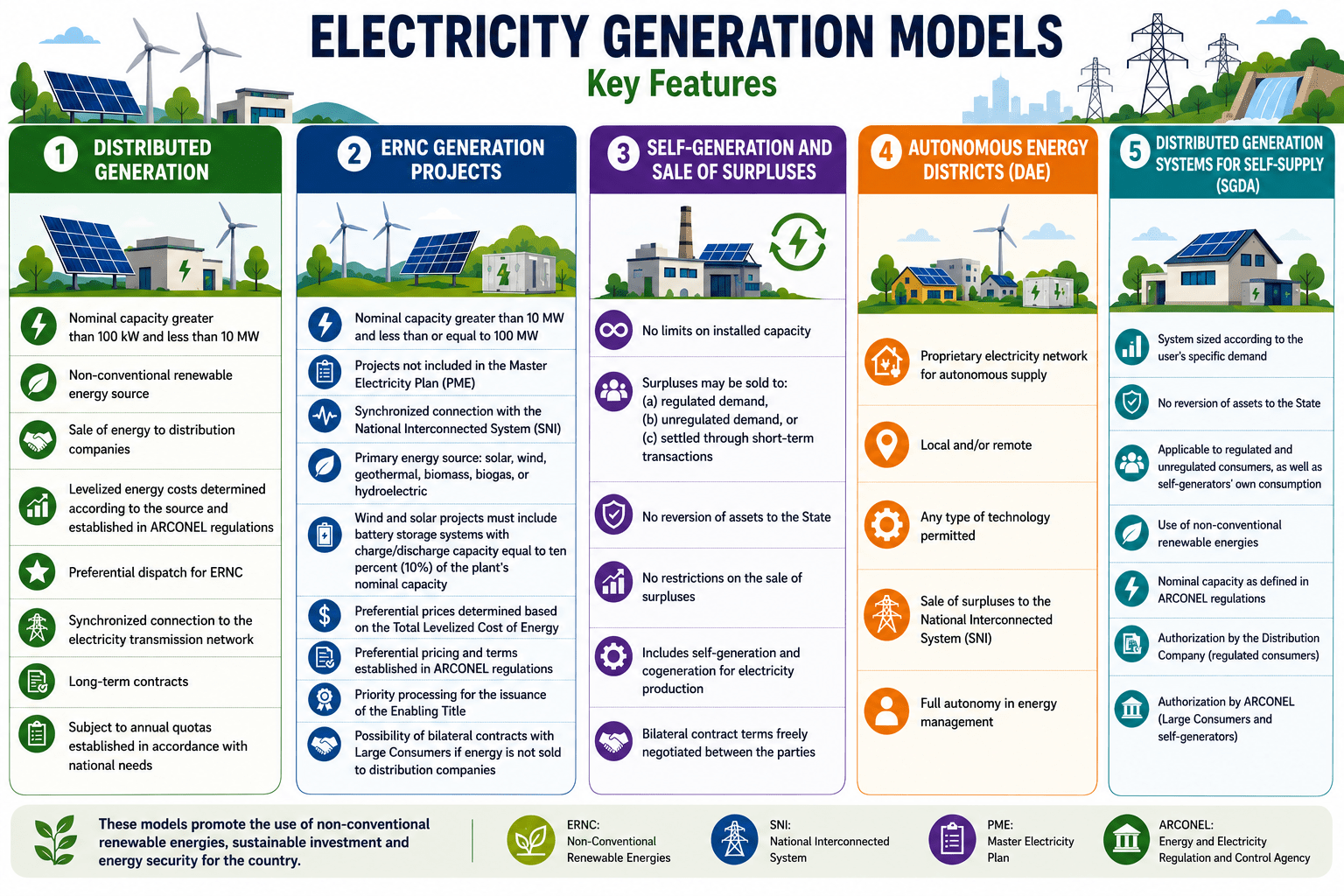
The current legal provisions enable the participation of the private sector in electricity generation activities through various models, each with its own particularities, opportunities, and benefits, which we outline in general terms below:
- Legal Background of Private Sector Participation in Energy Generation Activities
The Constitution of the Republic of Ecuador establishes the exclusive right of the Ecuadorian State to administer, regulate, control, and manage strategic sectors, defined as those that, due to their importance and magnitude, have a decisive influence on the economic, social, political, or environmental aspects of the country, including energy in all its forms.
Similarly, the Constitution defines the provision of public electricity services as an inherent responsibility of the State, which may exceptionally delegate the development of these activities to the private sector.
In this context, both the Organic Law on the Public Electricity Service (LOSPEE) and its Regulations (RLOSPEE) contain specific provisions that enable the participation of private companies in electricity generation, both for projects included in the Master Electricity Plan (PME) and for those not contemplated in said instrument.
Thus, in accordance with the aforementioned regulations, private sector participation in energy generation activities shall be subject to the limits established annually by the competent Ministry, the permitted transactions, and the terms and conditions set forth in the concession contracts (Enabling Titles) to be executed between the private generator and the Ecuadorian State. In no case shall this imply the transfer of ownership of the public service to the private sector or the waiver of the State’s powers of governance, regulation, and control.
- Relevant Regulations
In addition to the Constitution of the Republic of Ecuador, the Organic Law on the Public Electricity Service, and its Regulations, it is of particular importance to understand and analyze the specific regulations issued by the Agency for the Regulation and Control of Energy and Non-Renewable Natural Resources (ARCONEL), which develop and complement the primary legislation on the subject matter of this document.
The main applicable provisions are as follows:
- Regulation No. ARCERNNR-003/21: Regulates the qualification and participation of Large Consumers in the electricity sector.
- Regulation No. ARCONEL-005/21: Establishes the technical, operational, and commercial conditions for the participation of self-generators and cogenerators in the electricity sector.
- Regulation No. ARCONEL-005/24 (codified): Regulatory framework for distributed generation for the self-supply of regulated electricity consumers.
- Regulation No. ARCONEL-006/24: Regulatory framework for participation in distributed generation by companies interested in carrying out generation activities with Non-Conventional Renewable Energy (ERNC) (up to 10 MW).
- Regulation No. ARCONEL-010/24: Regulatory framework for distributed generation for the self-supply of unregulated consumers (large consumers and own consumption).
- Regulation No. ARCONEL-005/25: Regulations to promote generation with Non-Conventional Renewable Energy (ERNC) greater than 10 MW and less than or equal to 100 MW.
- Private Sector Participation
In light of the applicable legal provisions, private sector participation in energy generation activities can be approached from various perspectives, namely:
- a) To supply regulated demand, whether private generators have been selected through a public selection process (PPS) for the development of projects included in the PME or projects declared of public interest; or have identified projects not included in the PME and have decided to avail themselves of the specific regulations that guarantee the payment of a tariff and preferential dispatch by the State.
- To supply unregulated demand (Large Consumers), when the private generator does not wish to avail itself of the preferential conditions applicable to it and decides to develop the project at its own account and risk, selling the generated energy to Large Consumers through bilateral contracts.
- To supply its own demand under the self-generation modality, in which it may sell its surplus energy either to regulated demand or to Large Consumers through the execution of the corresponding commercial contracts.
- With respect to non-conventional renewable energies (ERNC) and transition energy, both the LOSPEE and the RLOSPEE establish the conditions applicable to generation projects with nominal capacities between 100 kW and 10 MW, and between 10 MW and 100 MW, subject to the prior execution of the corresponding Enabling Title. These projects shall also be subject to the specific regulations issued by ARCONEL for each power range.
- By way of an Autonomous Energy District (DAE), which consists of a generator that owns an electricity network intended to supply its own demand and which, on an exceptional basis, may make its surplus energy available to the national system.
- Through Distributed Generation Systems for Self-Supply (SGDA), whereby resources from any type of technology are used to self-supply the demand of end consumers connected to a distribution network, with any eventual surplus injected into the distribution network.
- Key Considerations:
- In accordance with the Constitution of the Republic of Ecuador, the management of the energy sector in all its phases is reserved to the State, which may exceptionally delegate its execution to private initiative through the mechanisms provided by law.
- The delegation of electricity generation activities to the private sector does not imply a waiver or limitation of the State’s exclusive right over the public electricity service, but rather the exercise of a constitutionally established power.
- The current regulatory framework contemplates various mechanisms for private sector participation in electricity generation, among which self-generation, distributed generation, and projects under enabling titles stand out, in accordance with the regulations and particularities referred to above.
- The selection of the most suitable generation modality will depend on the specific characteristics of each project (power capacity, technology, location, destination of the energy, and investor profile). Such a choice will have a direct impact on the profitability, technical, legal, and economic viability of the project.
- In principle, private generators and self-generators may only sell the energy produced to distribution companies (regulated demand) or to Large Consumers (unregulated demand), with the direct sale to end consumers being expressly prohibited.
- Strict compliance with the applicable formalities, technical, environmental, and regulatory requirements for each modality is an essential element in guaranteeing the viability, operability, and long-term sustainability of the project.
At Laspina Legal, we have extensive experience in providing legal and strategic advice for the evaluation, management, development, and operation of electricity generation projects. If your company requires specialized advice in this area, please do not hesitate to contact us! It will be a pleasure to assist you.